
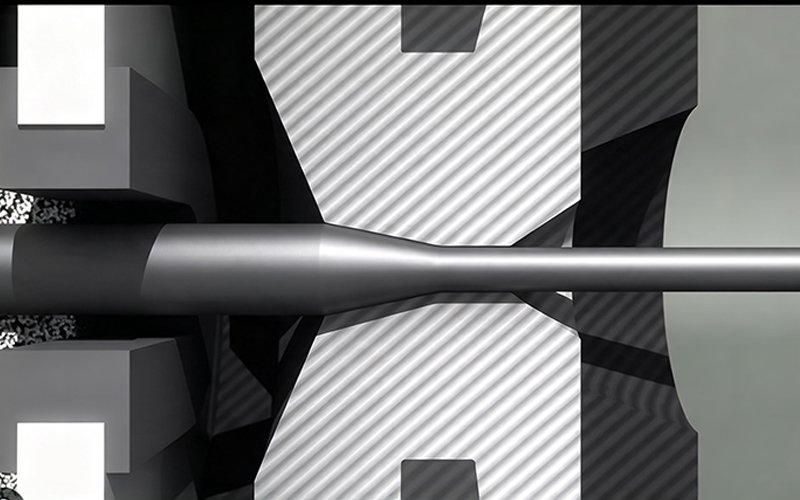
Steel wire drawing dies
Drawing dies are essential tools in cold drawn steel wire manufacturing. As steel wire passes through the die opening, it undergoes plastic deformation to reduce its diameter and achieve the required dimensions.
Die quality, dimensional accuracy, and wear condition directly affect wire diameter tolerance, surface finish, residual stress, and coil shape. These factors are particularly important in the production of high carbon spring steel wire and mattress spring wire.
1. How Drawing Dies Affect Steel Wire Quality
1.1 Controlling Wire Diameter Accuracy
The die opening and its geometric accuracy play a key role in controlling the final wire diameter. Die wear, chipping, or deformation can cause diameter fluctuations and dimensional deviations.
For downstream spring manufacturers, inconsistent wire diameter can lead to unstable feeding, variations in spring dimensions and mechanical performance, and difficulties in automated coiling operations.
1.2 Maintaining Surface Quality
The surface finish of the die’s working area directly affects the wire surface during drawing. Rough surfaces, scratches, or small chips inside the die can cause longitudinal scratches, grooves, and other surface defects.
These defects may act as stress concentration points, increasing the risk of crack initiation under cyclic loading. For spring steel wire, poor surface quality can reduce fatigue performance and increase the risk of spring failure.
1.3 Influencing Residual Stress and Coil Shape
The die approach angle, reduction zone geometry, and sizing section must be appropriate for the wire grade and drawing conditions.
Improper die geometry or uneven drawing conditions can contribute to nonuniform deformation and residual stress. The finished wire may also exhibit poor coil shape, excessive curvature, or an unstable payoff pattern.
During downstream processing, these problems can cause wire tangling, feeding interruptions, and reduced coiling efficiency.
1.4 Affecting Production Efficiency and Manufacturing Costs
Drawing dies with poor wear resistance may require frequent replacement, resulting in more downtime and lower production efficiency.
Damaged die surfaces can also scratch the wire, increasing the risk of defective products and material waste. Effective die selection, inspection, and maintenance help extend tool life and reduce overall manufacturing costs.
2. Best Practices for Drawing Die Management
2.1 Select Dies According to Material and Drawing Conditions
Die material and geometry should be selected according to the steel grade, wire diameter, reduction per pass, and drawing speed.
Cemented carbide dies are commonly used for applications requiring high wear resistance, including many high carbon steel wire drawing operations. The die geometry should be matched to the specific drawing process.
2.2 Inspect New Dies Before Use
Before installation, check the die opening diameter, roundness, working-surface finish, and overall condition.
Dies that fail to meet the required specifications should not be used in production. Incoming inspection helps prevent avoidable dimensional and surface-quality problems.
2.3 Monitor Die Wear During Production
Regularly inspect finished wire diameter and surface condition. Track die usage and wear trends, and replace dies when they reach established wear limits.
Timely replacement helps maintain consistent product quality and prevents damaged tooling from affecting subsequent production.
2.4 Repair or Replace Worn Dies
Dies with minor wear may be suitable for professional reconditioning and polishing, provided their geometry and dimensional accuracy can be restored.
Dies with cracks, significant chipping, or damage that cannot be reliably repaired should be removed from service. Reconditioned dies should be inspected before being returned to production.
2.5 Maintain Effective Drawing Lubrication
Proper surface preparation and lubrication—including suitable phosphating and soap-based drawing lubricants where applicable—help reduce friction between the wire and the die.
Effective lubrication can limit die wear, protect the wire surface, and support stable drawing performance. Lubrication conditions should be matched to the steel grade, drawing reduction, and production parameters.
3. Why Die Control Matters for Spring Steel Wire
For high carbon spring steel wire and mattress spring wire, dimensional consistency and surface integrity are important to downstream spring forming and service performance.
Effective die management helps manufacturers maintain:
- Consistent wire diameter: Supports stable feeding and accurate spring dimensions.
- Good surface quality: Reduces the risk of scratches and other surface defects.
- Stable drawing performance: Helps control process variation and coil consistency.
- Improved production efficiency: Reduces avoidable downtime, material waste, and tooling costs.
However, final wire quality depends on more than die condition alone. Raw material quality, drawing reduction, lubrication, process parameters, and inspection procedures also play important roles.
Conclusion
Drawing dies are a critical part of cold drawn steel wire manufacturing. Proper die selection, dimensional inspection, wear monitoring, and maintenance help control wire diameter, surface quality, and drawing stability.
For manufacturers of high carbon spring steel wire and mattress spring wire, systematic die management is an important part of consistent production and reliable product quality.
WANLIN METAL supplies high carbon spring steel wire and low carbon cold drawn steel wire for industrial applications. Contact our team to discuss your wire specifications and manufacturing requirements.
Wire straightness is also affected by drawing conditions, residual stress, and equipment alignment. Learn more about [the factors affecting cold drawn steel wire straightness].