
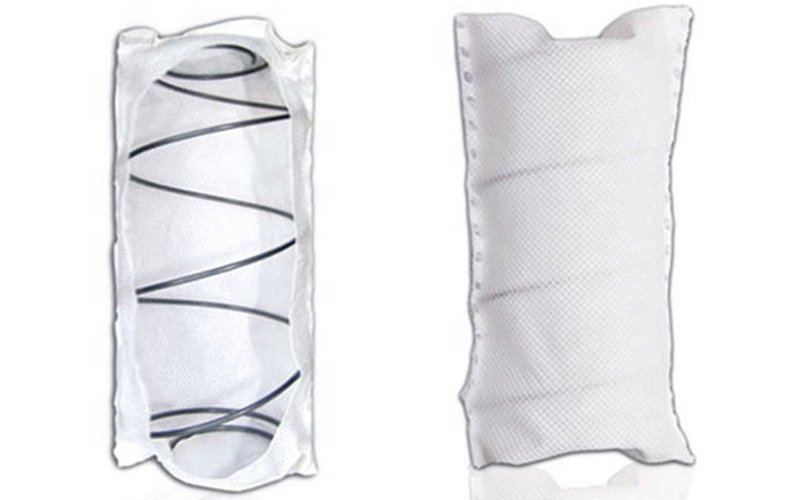
pocket spring wire
Mattress spring wire is typically made from high carbon cold-drawn spring steel wire and is a key material for providing support, elasticity, and long-term resilience in mattress spring systems.
A common misconception among buyers is that higher tensile strength always means longer fatigue life. In practice, the relationship is more complex. Mattress spring wire needs an appropriate combination of strength, toughness, surface quality, and manufacturing consistency to achieve reliable fatigue performance.
What Is Tensile Strength?
Tensile strength refers to the maximum stress that steel wire can withstand before it breaks.
For spring steel wire, tensile strength is influenced by factors such as:
- Carbon content
- Cold drawing reduction
- Heat treatment
- Steel grade
- Manufacturing process
Higher tensile strength can improve the wire’s resistance to deformation, but tensile strength alone does not determine fatigue life.
What Is Fatigue Life?
Mattress springs are subjected to repeated loading during normal use. When a person lies down, turns over, or applies pressure to a mattress, the springs repeatedly compress and recover.
This creates a cyclic loading condition.
Fatigue life refers to the number of load cycles a material or component can withstand before fatigue failure occurs under specified conditions.
For mattress spring systems, good fatigue performance is essential for maintaining consistent support and reducing permanent deformation over long-term use.
How Does Higher Tensile Strength Affect Fatigue Life?
When tensile strength is within an appropriate range, increasing strength can improve resistance to plastic deformation.
A stronger spring wire can withstand higher loads while maintaining its shape and elastic performance. This can help reduce permanent deformation and maintain mattress support during repeated use.
For high carbon spring steel wire, achieving the appropriate strength level together with suitable microstructure and controlled residual stress is important for long-term spring performance.
However, the relationship is not simply linear.
Why Higher Tensile Strength Is Not Always Better
If tensile strength becomes excessively high, the material may become less tolerant of defects and local stress concentrations.
Small surface scratches, drawing marks, or other manufacturing defects can act as potential crack initiation sites under repeated cyclic loading.
High-strength wire therefore requires careful control of:
- Surface quality
- Dimensional consistency
- Residual stress
- Microstructure
- Drawing process
- Heat treatment
When these factors are not properly controlled, fatigue performance may decrease even when the measured tensile strength is high.
Therefore, the objective should not be to achieve the highest possible tensile strength, but rather to achieve a balanced combination of strength, toughness, and fatigue resistance.
What Happens When Tensile Strength Is Too Low?
Insufficient tensile strength can also reduce the service performance of mattress springs.
When the wire does not have adequate yield strength, repeated compression may cause excessive plastic deformation. The spring may gradually lose its original shape and recovery ability.
This can contribute to reduced mattress support and permanent deformation over time.
Although lower-strength wire may have greater ductility and resistance to sudden fracture, excessive permanent deformation can still represent a form of spring failure.
Other Factors Affecting Fatigue Life
Tensile strength is only one factor affecting the fatigue performance of mattress spring wire.
Other important factors include:
Surface Quality
Surface scratches, defects, and drawing marks can create stress concentration points and potentially accelerate fatigue crack initiation.
Wire Diameter Tolerance
Consistent wire diameter helps ensure uniform spring forming and more predictable mechanical performance.
Residual Stress
The drawing and heat-treatment processes can influence residual stress within the wire. Proper process control helps maintain stable spring performance.
Spring Geometry
Coil diameter, pitch, number of turns, spring shape, and forming conditions can all affect the stress distribution within a spring.
Microstructure
The steel’s microstructure affects its strength, toughness, and fatigue behavior. Appropriate processing is therefore essential for achieving consistent properties.
Finding the Right Balance for Mattress Spring Wire
For mattress spring applications, selecting spring wire should not be based on tensile strength alone.
Manufacturers need to consider the design load, spring geometry, wire diameter, required compression performance, manufacturing process, and expected service conditions.
The target tensile strength should be selected within an appropriate range for the specific application, while drawing, heat treatment, surface condition, and dimensional tolerance must also be carefully controlled.
A balanced manufacturing approach can help achieve:
- Stable spring performance
- Good resistance to permanent deformation
- Consistent elastic recovery
- Reliable fatigue performance
- Longer service life
Conclusion
The relationship between tensile strength and fatigue life in mattress spring wire is not simply “higher is better.”
An appropriate tensile strength can improve load-bearing capacity and resistance to permanent deformation. However, excessively high strength may increase sensitivity to surface defects, residual stress, and other manufacturing factors.
For this reason, reliable mattress spring wire requires a balanced combination of tensile strength, toughness, surface quality, dimensional accuracy, microstructure, and process control.
At WANLIN METAL, high carbon spring steel wire is manufactured according to specified wire diameters, tensile strength requirements, dimensional tolerances, and application conditions.
Looking for spring steel wire for pocket springs, Bonnell springs, or other mattress applications? Contact WANLIN METAL to discuss your requirements.