High Carbon Steel Wire Drawing Process
High carbon steel wire is an important industrial material widely used in spring manufacturing, mechanical components, automotive parts, and other applications requiring high strength and reliable performance.
It is primarily made from iron with a relatively high carbon content. Compared with low carbon steel wire, high carbon steel wire can achieve greater tensile strength and hardness through appropriate manufacturing processes. These properties make it suitable for applications where strength, elasticity, and wear resistance are important.
1. What Is High Carbon Steel Wire?
High carbon steel wire is manufactured from high carbon steel, which generally contains approximately 0.60%–1.00% carbon, depending on the steel grade and applicable classification.
The higher carbon content increases the steel’s potential hardness and strength. However, it can also reduce ductility and make the material more sensitive to processing conditions.
Common high carbon steel grades If you are comparing different steel materials, learn more about the [differences between high carbon steel and low carbon steel].used in industrial wire production include:
- 65#
- 70#
- 65Mn
- 77B
- 82B
The appropriate grade depends on the required tensile strength, wire diameter, forming conditions, and final application.
To better understand its chemical composition and mechanical characteristics, read more about [high carbon steel properties and benefits].
2. How Is High Carbon Steel Wire Manufactured?
The production of high carbon steel wire involves several stages. Each stage influences the final wire’s mechanical properties, surface quality, and dimensional accuracy.
Steelmaking and Casting
Raw materials are melted and refined to achieve the required chemical composition. The molten steel is then cast into billets for further processing.
Hot Rolling
Steel billets are heated and rolled into wire rod. The chemical composition and quality of the wire rod provide the foundation for subsequent wire drawing.
Surface Preparation
Before drawing, the wire rod may undergo pickling or mechanical descaling to remove surface scale. Phosphating and lubrication may also be used to prepare the surface for cold drawing.
Cold Drawing
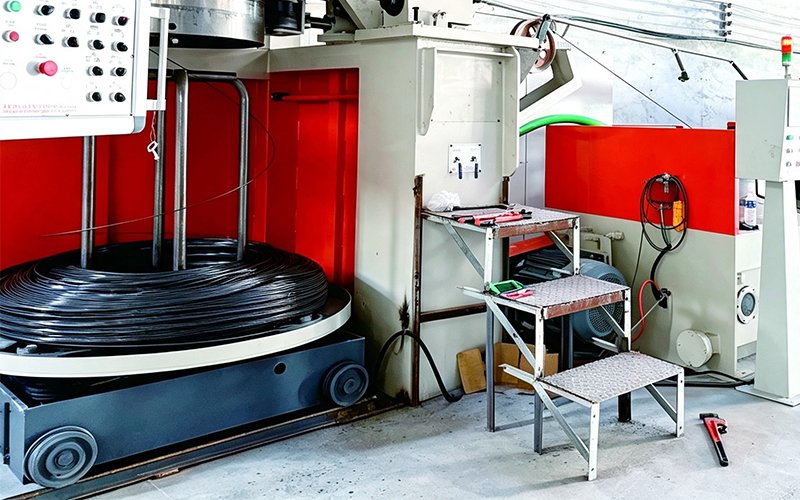
The prepared wire rod passes through drawing dies to reduce its diameter and achieve the required dimensions. Controlled drawing conditions help improve dimensional consistency and mechanical properties.
The condition and precision of drawing dies play an important role in wire diameter accuracy and surface quality. Learn more about [why drawing dies matter in cold drawn steel wire production].
Heat Treatment and Surface Treatment
Depending on the steel grade and product requirements, heat treatment or other processing steps may be applied to achieve the desired mechanical properties. Surface treatments can also be selected according to the intended application.
Inspection and Packaging
Finished steel wire is inspected for diameter, tensile strength, surface condition, and other specified requirements before packaging and delivery.
3. Key Properties of High Carbon Steel Wire
High carbon steel wire offers several important properties for industrial applications.
High Tensile Strength
With suitable material selection and processing, high carbon steel wire can achieve high tensile strength, making it suitable for components exposed to significant mechanical loads.
Hardness and Wear Resistance
Its relatively high carbon content provides good potential for hardness and wear resistance after appropriate processing.
Elastic Performance
High carbon spring steel wire can provide suitable elastic performance when its material composition and manufacturing process are properly controlled. This makes it widely used in spring applications.
Controlled Dimensional Accuracy
Precision cold drawing helps manufacturers achieve consistent wire diameters and dimensional tolerances, supporting stable downstream forming and production.
4. Advantages and Disadvantages of High Carbon Steel Wire
Like other engineering materials, high carbon steel wire has both advantages and limitations.
Advantages
- High tensile strength after suitable processing
- Good hardness and wear resistance
- Suitable for spring and high-strength components
- Available in different steel grades and diameters
- Can be processed into various industrial wire products
Disadvantages
- Generally lower ductility than low carbon steel
- Requires careful control during drawing and forming
- Weldability is generally more challenging
- Excessive stress or unsuitable processing conditions may increase the risk of cracking or fracture
For these reasons, selecting the correct steel grade and controlling the manufacturing process are essential for achieving reliable product performance.
5. Applications of High Carbon Steel Wire
High carbon steel wire is widely used in industries that require strength, elasticity, and reliable mechanical performance.
Spring Manufacturing
One of its major applications is spring production, including:
- Pocket spring wire
- Bonnell spring wire
- Helical connecting wire
- Compression and tension springs
- Other industrial spring components
For mattress spring applications, tensile strength is one of several factors affecting product durability. Read more about [how tensile strength affects the fatigue life of mattress spring wire].
Automotive Industry
High carbon steel and alloy spring steel are used in selected automotive components, including spring-related parts and other high-strength applications.
Mechanical and Industrial Components
Depending on the grade and processing conditions, high carbon steel wire can also be used in wire ropes, mechanical components, and wear-resistant products.
6. How to Choose the Right High Carbon Steel Wire
Choosing the right high carbon steel wire requires more than simply selecting a carbon content or steel grade.
Manufacturers should consider:
- Steel Grade: Select a suitable grade based on the application and required mechanical properties.
- Wire Diameter: Confirm the required diameter and dimensional tolerance.
- Tensile Strength: Match the strength range to the product design and operating conditions.
- Surface Quality: Check for scratches, cracks, scale, and other surface defects.
- Processing Requirements: Consider drawing, heat treatment, forming, and subsequent manufacturing operations.
- Quality Inspection: Verify that the finished wire meets the agreed technical specifications.
Conclusion
High carbon steel wire is an important material for spring manufacturing and other industrial applications requiring high strength and suitable mechanical properties.
Its final performance depends not only on carbon content but also on steel grade, wire diameter, drawing conditions, heat treatment where applicable, and surface quality.
WANLIN METAL supplies high carbon spring steel wire in grades including 65#, 70#, 65Mn, 77B, and 82B. With available diameters from 0.30 mm to 8.00 mm, we support customized specifications for mattress spring manufacturing and other industrial applications.
Contact WANLIN METAL to discuss your steel wire requirements.